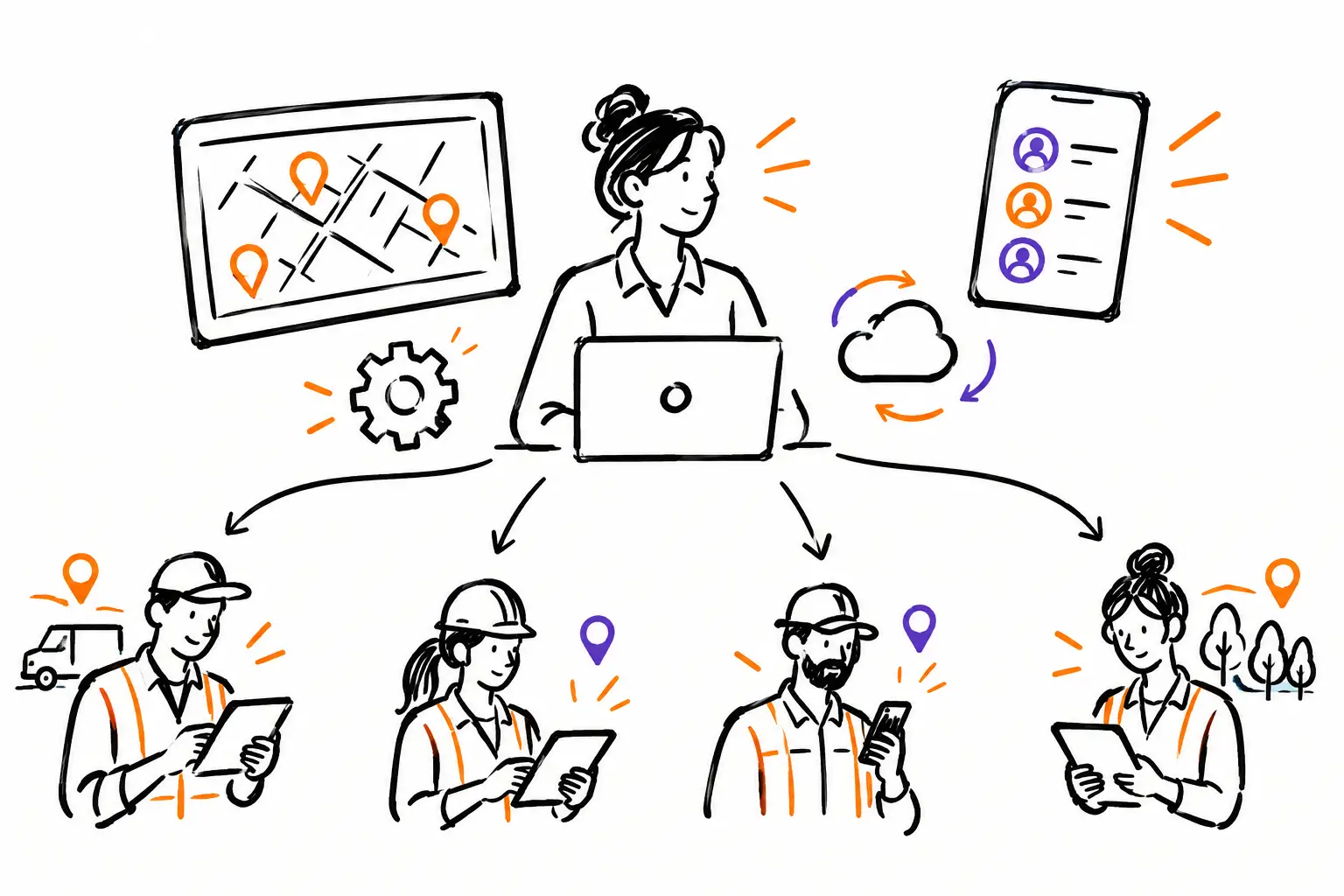
At 4:30 PM, the job is done, but the information is still missing. One technician left the site without logging their time, another noted their hours on their phone, and the office is waiting for Friday's timesheets to prepare payroll and invoices. Field team time tracking then becomes a race for follow-ups rather than a management tool.
The problem isn't just knowing who worked how many hours. You also need to know which work order it was for, which client, at what stage of the mandate, and with what expenses and parts. When this data lives in Excel sheets, text messages, and crumpled papers in trucks, the company loses time twice: once in the field, and a second time at the office.
Time should follow the work, not be hunted down
An isolated timesheet provides a total. It doesn't tell the story of what was done. For an SME in services, construction, maintenance, or property management, this context makes all the difference.
An hour logged should be attached to the document that organizes the work: work order, mandate, service ticket, or project. The manager can then see that a team spent six hours at a client's site, that two hours were planned for an inspection, and that the rest came from a repair added on-site. The office doesn't have to reconstruct the story from a call or email sent three days later.
This link also changes the conversation with the client. If an invoice raises a question, you don't respond with a vague total. You can retrieve the hours, tasks performed, photos, comments, and approval associated with the intervention. Billing becomes more defensible, without turning employees into administrative clerks.
What effective field time tracking must capture
The right level of detail depends on the trade. An excavation company will want to distinguish labor hours from machinery hours. A technical services firm will want to know which technician performed which procedure. A specialized workshop might track time by manufacturing stage. Imposing the same form on all these realities creates workarounds.
The useful minimum, however, remains clear: the person, the date, the duration, and the relevant work document. To this, you can add the type of hour, the task, the intervention status, notes, and client or supervisor validation. The goal is not to have everything filled out. The goal is to capture what allows you to manage, pay, and invoice correctly.
An efficient mobile entry must be quick, even between appointments. The employee opens their work order, starts or adds their time, indicates what was done, and moves to the next file. If they have to search for a client code, copy an address, or fill out ten fields that are never used, adoption will crumble. The best tool is one that respects the real rhythm of a field day.
Planned hours and actual hours do not serve the same purpose
Planning hours helps distribute teams and promise a realistic date to the client. Logging actual hours serves to understand the cost of the work performed. Both must be comparable, but they should not be confused.
Take a mandate scheduled for eight hours. If the team logs twelve, it is not automatically a performance issue. The client may have requested an addition, a part may have been missing, or site conditions may have slowed down the intervention. When hours are linked to the work order and accompanied by a note, the manager sees the gap and the reason for it. They can adjust the invoice, review the quote, or correct the planning for the next mandate.
Without this information, you only get a surprise at the end of the month: lower margins, without knowing why.
Putting an end to Friday follow-ups
Late timesheets have a cost that goes beyond a few minutes of entry. They delay the validation of hours, payroll preparation, project cost analysis, and invoice sending. They also force the coordinator to play detective: Who was on-site? How long? Is it billable? Is the task finished?
The solution isn't necessarily to monitor more. You need to make tracking visible within the workflow. A work document can move from planned to in progress, then to completed. At each stage, the expected and logged hours are accessible to the right person. The manager can follow up on missing data the same day, while the context is still fresh.
This approach is fairer for the team. A specific request, linked to a work order, is simpler to correct than a general message sent on Friday afternoon asking to submit all the week's hours. It also reduces memory-based estimates, which often end up inflating or forgetting billable time.
Validate without slowing down operations
Validation must follow the level of risk. For a small team performing short interventions, approval from the manager at the end of the day may suffice. For a high-value project or a contract with compliance rules, it may be relevant to require a client signature, photos, or task confirmation before closing the document.
The essential thing is to provide for an exception without blocking everyone. An employee must be able to correct a forgotten hour, but the correction must leave a trace. A manager must be able to approve an unusual entry, but without exporting and re-importing files. Traceability protects the company without adding a layer of unnecessary bureaucracy.
Circulating hours until the invoice
A well-logged hour only has administrative value if it avoids re-entry. When the same system links the work order, tasks, hours, expenses, and invoice, the office can transform completed work into billable revenue much faster.
The path is concrete: an accepted quote becomes a work document; the team adds their time and billable items to it; the manager validates the intervention; the ready data is pulled into the invoice. Depending on your rules, some hours can be included in a fixed price, others billed at the agreed rate, and others classified as non-billable. Your methods should decide how the software behaves.
This distinction is particularly useful for unforeseen work. A technician can note two extra hours to be approved. The coordinator sees them before the invoice goes out and chooses to bill them, absorb them as a commercial gesture, or create an addendum. Nothing is lost between the truck and the office.
Sequentia allows you to centralize this work document according to your vocabulary and your way of delivering service. For some, it will be a work order. For others, a ticket, a mandate, or a project file. The principle remains the same: information is entered once, where the work happens, then serves the teams who need it.
Measuring what actually helps you decide
Dashboards do not replace a manager's judgment. However, they provide a more reliable view than end-of-week impressions. With hours linked to operations, you can track team load, gaps between planned and actual, unbilled hours, interventions with delayed validation, and profitability by type of work.
You must resist the temptation to measure everything. If your challenge is to invoice faster, look first at the delay between the end of the work and the invoice. If your challenge is to protect your margins, monitor hour gaps on comparable mandates. If you have difficulty distributing the load, analyze the planned and actual hours by team. A useful indicator leads to a concrete decision.
Data also becomes a good tool for discussing with employees. Rather than stating that a team is taking too long, you can examine a type of intervention, the constraints encountered, and the procedures followed. The discussion focuses on the work, not on a perception.
Start simply, then adjust
A change in time tracking often fails because people want to standardize everything from the first day. Start with a frequent document type, such as service work orders. Define the essential fields, the people who validate, and the moment when an hour becomes billable. After a few weeks, observe the missing entries and the questions that keep coming up.
You might discover that a field is never used, that a procedure needs to be added, or that a status is missing between in progress and completed. That is normal. An efficient SME does not copy the process of a large company. It builds a tracking system that takes into account its trade, its clients, and its teams.
The real gain comes when no one needs to ask where the hours are anymore. They are already in the right place, with the work they explain, ready to support a decision or become an invoice.