A full schedule is no proof that your operations are under control. If a dispatcher has to call three people to find out if a job is finished, if timesheets arrive on Friday, and if invoices are still waiting for information, the problem goes beyond scheduling. This scheduling tool comparison is for SMEs that want to see work progress from the work order all the way to the invoice.
For a service, construction, maintenance, or property management company, a scheduling tool must do more than display colored boxes. It must help the office assign the right people, give the field the right instructions, and bring back complete proof of the work performed. Otherwise, you gain a calendar, but you keep the calls, texts, and double entry.
Scheduling tool comparison: the 4 main approaches
Not all tools meet the same needs. Before comparing features, it is necessary to distinguish what each category is actually trying to improve.
1. The shared calendar
A shared calendar is suitable for a small team that mainly needs to know who is available and where they need to be. It is quick to adopt, familiar, and often inexpensive. To book a time slot, move an appointment, or share a weekly schedule, it gets the job done.
Its limit appears as soon as the intervention involves tasks, photos, parts, risks to report, or customer approval. The event indicates that a technician is at a client's site from 9 a.m. to 11 a.m., but it doesn't always say what was done, what remains to be done, or what needs to be billed. Information then ends up in emails, texts, or the team's memory.
2. The project management tool
Project management platforms are useful for breaking a mandate into steps, assigning tasks, and tracking deadlines. They are well-suited for agencies, production teams, or projects with multiple administrative deliverables. Their strength is visibility into progress and responsibilities.
However, they can become cumbersome in the field. An employee performing a repair or inspection shouldn't have to search between several boards to find instructions, attach a photo, and enter their time. If the project doesn't match the document actually used by your teams—work order, service ticket, mandate, or inspection report—adoption slows down.
3. The field dispatch software
A dispatch tool generally adds a map view, routes, service windows, and notifications for technicians. It is a good choice when the main challenge is quickly sending the right person to the right place. In emergency services or companies that perform many short visits, this capability has real value.
However, you must check what happens after the assignment. Can you complete a procedure on mobile? Log hours, materials used, and expenses? Get the client to sign? Turn the completed file into an invoice? Some tools stop at dispatch. Others also cover execution but impose a rigid form that doesn't follow your way of working.
4. The operational platform centered on the work document
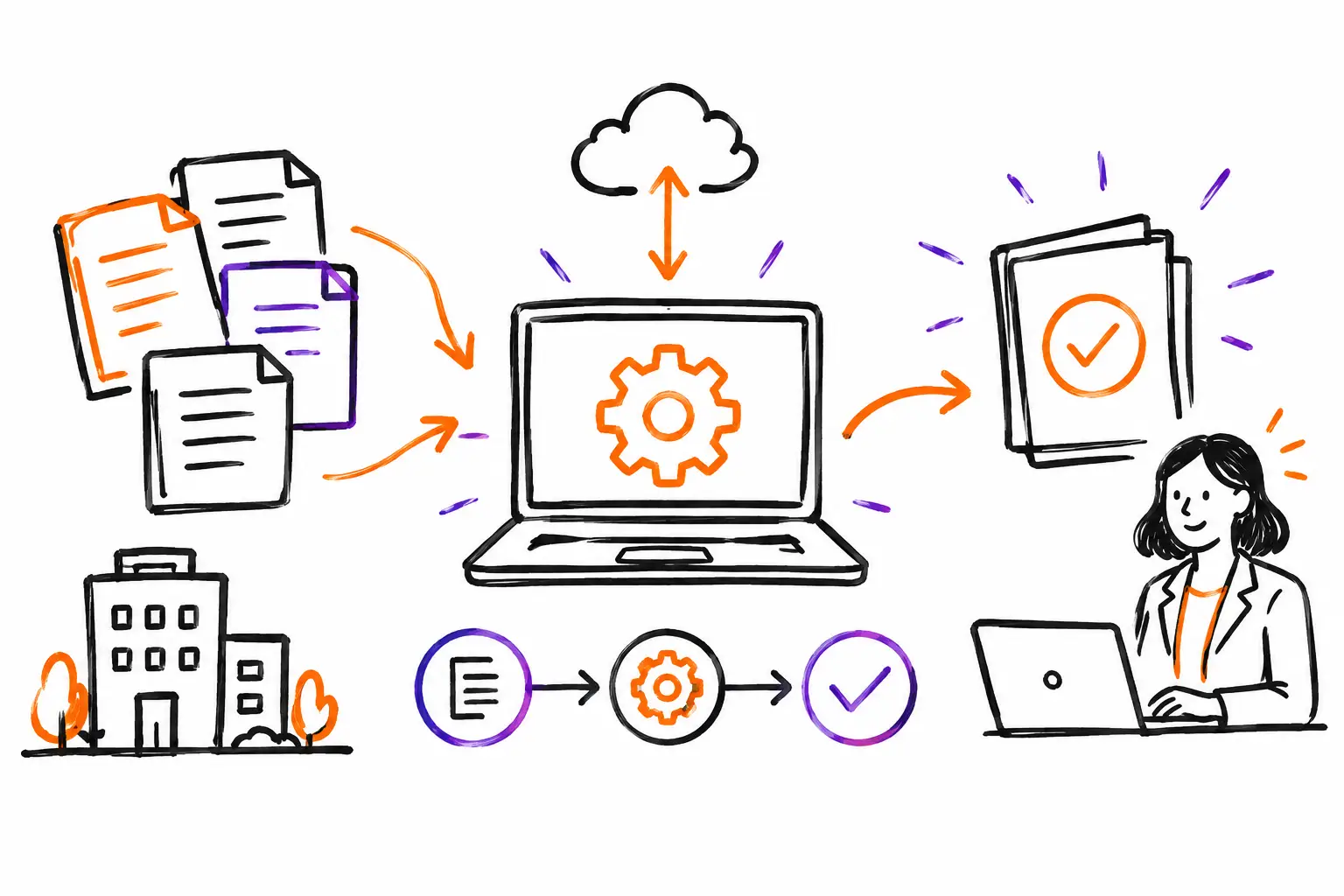
This approach uses the business document as a starting point. A mandate, work order, or ticket becomes the single file where you gather scheduling, tasks, procedures, communications, photos, time, expenses, and validations. The office plans in the same place where the field executes.
This is often the most relevant option when scheduling must lead to proof of work and accurate billing. It does, however, require initial reflection: what statuses do you use, what information must be mandatory, and who validates what? For an SME with its own unique method, this configuration is not a complication. It is what avoids forcing the business into a generic model.
The criteria that really change the choice
Comparing only the price per user gives an incomplete picture. The real cost is hidden in the minutes lost every day: a missing timesheet, an unfound photo, an unbilled part, a client called back to confirm what was done.
Scheduling must start from real work
Ask yourself what you are scheduling. Are you planning a presence in a time slot or a specific job to be done? In the latter case, the schedule should be linked to a file including the address, contact, relevant equipment, instructions, and client history.
Take a maintenance company. The coordinator creates a work order for a preventive visit, assigns two employees, and schedules the date. On mobile, the team sees the procedure, checks off steps, takes photos, and enters the time spent. Upon return, the office doesn't have to reconstruct the intervention. It can verify the complete file and bill according to the elements actually entered.
Mobile must be simple, even away from the office
A mobile application only has value if teams use it between interventions, in a truck, or at the client's site. Check the speed of access to files, the ease of adding photos, and the clarity of actions to take. A screen full of menus might work in front of a computer but be ignored on a job site.
You must also consider connectivity. If your teams work in basements, rural areas, or industrial buildings, ask how the tool handles unstable connections. The best process is one that remains workable when the day doesn't go as planned.
Statuses must serve coordination
"Planned," "in progress," and "completed" are a base, but your reality may require more precision: waiting for parts, visit postponed, validation required, ready to bill, or invoice sent. Adapted statuses give the manager a quick reading of the workload without requiring them to track every exchange.
The rule is simple: each status must trigger a decision or inform a person. Too many statuses create confusion. Not enough statuses hide bottlenecks. The tool must allow you to keep the level of detail useful to your team.
Billing must not start from scratch
This is where many scheduling software programs show their limits. They know how to assign an intervention, but the collected data must then be copied into billing software or a spreadsheet. This re-entry creates errors and delays payments.
Look for a continuous flow: quote, work document, hours and materials entered, validation, then invoice. When operational data feeds the invoice, you bill faster and can better explain what is being billed. For the client, the file is clear. For the administration, hours no longer disappear in a late email.
How to test a tool before choosing it
Don't settle for a demonstration full of features. Take a recent intervention, ideally one that had an unforeseen event, and ask to reproduce its path in the tool. Create the file, assign the team, change the schedule, add a photo, log an expense, have the work approved, and prepare the invoice.
This test quickly reveals blind spots. If information must be entered in two places, if the field doesn't see the right instruction, or if the manager has to export a file to know which interventions are ready to bill, you will know before deployment.
Also involve the people who will do the daily work: dispatcher, foreman, technician, and administrative manager. The leader looks for an overview, but adoption often happens in simple gestures: finding a work order, changing a status, and entering time without wasting time.
The right tool respects your work method
There is no "best" scheduling tool for all SMEs. A calendar may suffice for a team that organizes a few appointments per week. A dispatch solution is suitable for a fleet that needs to optimize travel. But when every visit produces hours, proof, expenses, and an invoice, a complete operational platform becomes more logical.
This is the approach proposed by Sequentia: start from your work document and configure it according to your business, rather than asking you to bypass your own method. You keep a single source of information between the field, the office, and the administration.
The right choice is therefore not measured by the number of boxes in the agenda. It is measured by what happens after the assignment: the team knows what to do, the work is traceable, the client is well served, and the invoice can go out without chasing information.