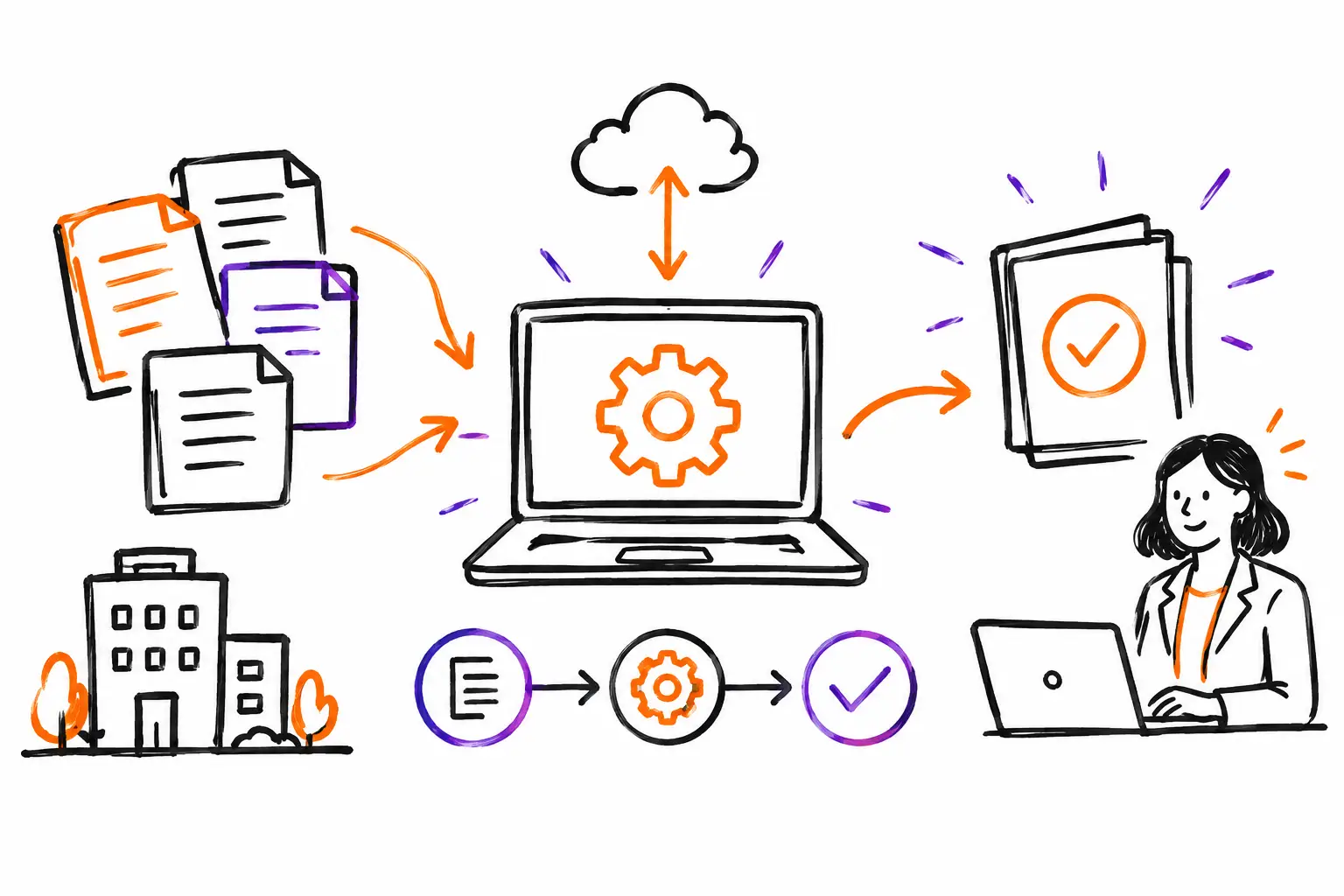
A completed field work order, a photo added after the intervention, hours entered on Friday, and an invoice prepared on Monday: this is often where the choice between an ERP or operations software becomes very concrete. The problem isn't just about storing data. The office needs to know what was done, the client must be billed correctly, and the team shouldn't have to explain the same intervention twice.
For an SME in services, construction, maintenance, or project management, the right tool is one that tracks the actual work. An ERP can meet this need in certain contexts. Operations software may be more accurate in others. The difference mainly lies in the starting point: the administrative management of the company or the work document that drives the intervention forward.
ERP or operations software: two starting points
An ERP, or enterprise resource planning software, aims to unite the major functions of the company: accounting, purchasing, sales, inventory, human resources, finance, and sometimes production. Its goal is to provide a structured view of the organization and reduce silos between departments.
This is a useful approach when a company needs to manage multiple entities, complex accounting rules, centralized purchasing, or a large volume of stock and transactions. The ERP then becomes the administrative backbone. It helps control what comes in, what goes out, and what needs to be reported or analyzed.
Operations software starts from a different place: the work to be delivered. Its central unit is not necessarily the order, the invoice, or the accounting entry. It is the work order, the mandate, the ticket, the project, or the client intervention. Around this document, you gather tasks, procedures, photos, time, exchanges, expenses, and approvals.
This difference seems simple, but it changes the team experience. In the field, a technician doesn't think in ERP modules. They want to know where to go, what to do, which procedure to follow, what parts to use, and what they need to have approved before leaving the site.
When an ERP meets the need
An ERP is often a good choice if the main difficulty lies in financial management and cross-functional processes. This is the case, for example, for a company that needs to consolidate data from multiple divisions, control complex supplies, or manage manufacturing with precise bills of materials.
It can also be suitable for an SME whose operations are relatively simple or stable. If teams work little in the field, and interventions do not require photos, forms, signatures, or detailed reports, the standard capabilities of an ERP may suffice.
However, you must check what people will actually do in the tool. An ERP can very well produce financial reports, but be less natural for a foreman who needs to distribute calls, track delays, attach a plan to a work order, and collect a client signature on a mobile device.
The risk is not choosing a bad system. The risk is asking an administrative system to solve, on its own, the problems of field execution. When the process is cumbersome, teams bypass the tool: notes on a phone, photos in a group chat, hours on paper, and details transmitted verbally to the office. Double entry returns almost immediately.
When operations software becomes a priority
Operations software makes the most sense when a company lives to the rhythm of interventions, projects, or mobile teams. The daily challenge is then to keep every file complete, circulate information, and transform the work performed into billable revenue.
Take a technical maintenance company. The coordinator receives a client request and creates a work document. They assign the intervention to a technician, add instructions, relevant equipment, and the scheduled date. On-site, the technician checks off steps, adds photos, records their hours and parts used, and then obtains client validation.
The office doesn't have to reconstruct the history of the intervention. Data entered during the work directly feeds the invoice preparation. If an anomaly was reported, it remains associated with the same file. If the client disputes an invoice line, you can find the photos, the signature, and the time actually declared.
It is this continuous flow - from request to work, then from work to invoice - that gives operations software its value. It does not automatically replace accounting. Above all, it prevents information from arriving too late, incomplete, or in five different places.
The true criterion: your business document
Before comparing features, look at the document that organizes your activity. For you, is it a work order, an inspection sheet, a construction file, a production mandate, a service request, or a project? It is often this document that should guide the choice of platform.
A generic tool sometimes imposes fields and steps that do not correspond to your reality. Conversely, overly specialized software can lack flexibility as your services evolve. The right solution should allow you to structure your method without distorting it.
For example, an excavation company may need to associate machinery hours, materials, before-and-after photos, permits, and transport costs with the file. A production agency will instead track deliverables, client approvals, hours per project, and expenses to be rebilled. In both cases, the document is different, but the need remains the same: to have a single reliable source of the work accomplished.
This is also where you must distinguish configuration from custom software development. Configuring means adapting statuses, forms, roles, fields, and automations to a known method. Custom development becomes relevant when a specific business process needs to be connected to another system or brings a real advantage to the company. Customizing everything is not always a good idea: it can make updates heavier and complicate training.
Evaluate the complete journey, not just the features
A convincing demonstration often shows a list of functions: tasks, inventory, invoicing, calendar, reports. But an SME should primarily ask to see a complete scenario with its own steps.
Start with a client request. How does it become a quote? What happens after acceptance? How is the work order assigned? What does the person see on mobile? Where do they enter their hours, expenses, and photos? Who validates the file? How do billable items reach the invoice? And, finally, what does accounting receive?
This journey quickly reveals friction points. If the coordinator has to copy an address into the calendar, if the technician has to re-enter parts in another module, or if the administrator has to transcribe hours into the accounting software, the system hasn't truly connected the operations.
Indicators must follow the same logic. A good dashboard isn't just for displaying monthly revenue. It must help answer field questions: which work orders are awaiting validation, which interventions are exceeding the planned time, which invoices are ready, which projects are consuming more hours than expected?
Should you choose one or the other?
Not always. Many SMEs benefit from keeping their accounting software or ERP for finances, while using an operations tool to manage execution. The challenge then is integration: useful information must flow without creating duplicates or endless manual reconciliations.
This combination works well when each system has a clear role. The operations software becomes the reference for work, teams, proof of execution, and items to be billed. The accounting system or ERP remains the reference for entries, taxes, payments, and financial analysis.
For a small team, it is rarely necessary to start with a heavy deployment. It is better to start with a priority flow, such as quote → work order → invoice, then add procedures, inventory, or dashboards as you go. Adoption is easier when each person immediately sees what they gain: fewer calls, fewer lost sheets, less time searching for information.
Sequentia follows this logic by placing the business document at the center of the platform, so that the field, the office, and the billing department work from the same file.
The best choice, therefore, does not come down to the label ERP or operations software. Take a real work order from your company, follow it from the first call to payment, then choose the tool that removes the most relays, re-entry, and uncertainty about what was actually done.